
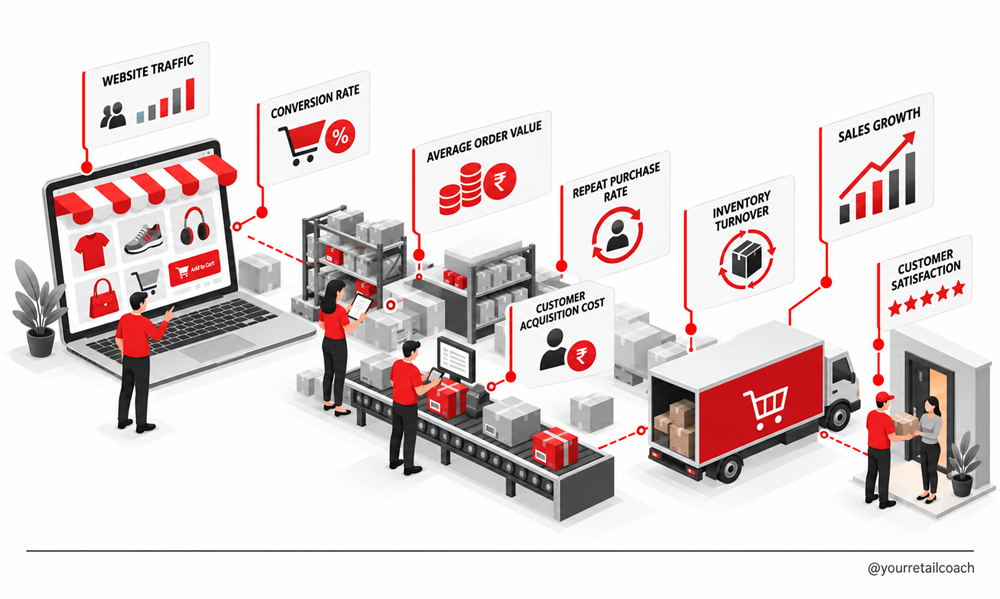
Key ECommerce Business Metrics Every Online Store Should Track
ECommerce is a way of doing business that is heavily reliant on technology. Where there is technology, there is data. Data can be tracked and collected. This opens up a window of opportunity for eCommerce-based enterprises to leverage technology for data analytics.
Analytics has allowed eCommerce brands and businesses to assess many crucial aspects of their efforts, performances, and results. But it is important for businesses to know what they should be looking for and assessing in terms of numbers and statistics. An in-depth understanding of the eCommerce metrics helps in making quick assessments and improvements for better business.
Further in this content, the eCommerce business consultants of Your Retail Coach highlight twelve essential eCommerce business metrics.
Customer-Oriented Metrics (5)
Customer Lifetime Value (CLV)
Customer Lifetime Value (CLV) signifies the total revenue expected to come from a single customer in the entire span of the relationship. It lets businesses assess the worth of enduring relations with customers. It assists in ascertaining the nature and quantum of investment in customer acquisition. This goes a long way in building a strong base of loyal customers.
CLV = Order Value × Purchase Frequency × Expected Duration of the Relationship
For instance, if the said numbers for a customer are:
Average Order Value: 1000
Purchase Frequency: 4
Customer Lifespan: 5
Then, the CLV is (1000x4x5) = 20,000. This approach provides a statistical point (instead of having none) on how to invest resources and efforts for customer acquisition. Please note that CLV could also be calculated for an entire customer segment as an average.
Customer Acquisition Cost (CAC)
Customer Acquisition Cost (CAC) is the total investment made by an enterprise for acquiring 1 new customer. The costs cover expenses made to run online and offline advertising campaigns, special discounts offered and availed by new customers, compensation paid to sales and marketing employees (e.g. incentives, TA/DA), share of attributable overhead expenses (e.g. rent and utilities), IT expenses, fees to consultants, etc.
CAC (for a given period) = Total Costs Incurred in Marketing and Promotions
Total New Acquisition Number
For example, if the numbers for the numerator and denominator are 20,000 and 2000, respectively, then the CAC for the given period is 1000.
Having CAC numbers helps businesses in many strategic assessments and decisions, like evaluating the effectiveness of the ongoing efforts for customer acquisition and budgeting and resource allocation for marketing and sales.
CLV:CAC Ratio
Drawing the same numbers from the two points discussed above, if CLV is 20,000 and CAC is 1000, then it could be concluded that every new customer acquired is likely to give 20 times ROI. It is a highly unrealistic scenario, but it highlights the importance of having the CLV and CAC metrics. Industry standards quote 3:1 as the ideal balance between the two. If this ratio is lower than the ideal, rationality would point fingers at overspending or underperformance. Anything higher than the ideal could also mean undermining of market potential and under-investment in acquisition efforts.
Customer Retention Rate (CRR)
How many people wished you personally on New Year’s Eve? You somehow recollect that last year it was 20. This year the number is 18. So, did you lose two well-wishers? Could be, but what if you also made 5 new friends this year and all of them showed up in your inbox? So, leaving these 5 individuals aside, 13 of the old folks cared to remember you. Those 13 individuals are your retention. If you want to see a score out of it, just put the numbers in context. That will look like 13/20 x 100 = 65%. This epitomizes the core of CRR and formalised as:
CRR = Existing Customers – New acquisitions x 100
Customers in the beginning (last year ending)
While it is good that you are making new friends and unfortunate that some of the old ones are drifting away, you should not ignore the ones who are still with you. These old folks have shown greater loyalty and association with you. In business, too, customers who stayed loyal to you should matter to you.
Brand Advocate Score (BAS)
Brand Advocate Score (BAS) is a measure of customer delight and brand loyalty and reflects that cluster of customers who would recommend your brand to others. Data inputs for calculating BAS are usually done through simple surveys. The idea for keeping it simple is to make it easier for customers to quickly state their opinion on a given scale. BAS is calculated as:
BAS = Number of Brand Advocates
Total Number of Unique Responses in the Survey
For example, on a scale of 10, responders who marked anything above 8 could be regarded as brand advocates in a direct question on brand advocacy. Companies may have different approaches to designing the survey questions and answers and the means to arrive at conclusions.
Conversion & Sales Metrics (4)
Conversion Rate (CR)
If you visit a store and do not make any purchase, you will be regarded as a prospect who did not convert into a customer or a buyer. If your friend also visited the store the same day and he made a purchase, he will be regarded as a conversion. In essence, conversion rate measures how many of the total prospects turned into customers over a given period. The same applies to eCommerce when prospective customers visit the online store of a brand. In the eCommerce analytics parlance, the word ‘session’ is used to indicate one visit. If you visit a website two times in a day, the session count will be two. In the context of CR, every session is an opportunity for creating a conversion, irrespective of whether the session is made by a new prospect or an existing customer. Conversion Rate is calculated as:
(Purchase Count / Session Count) x 100
Please note that different companies may assign different meanings to conversion. For example, adding a product to the wishlist may also count as a conversion of a certain assigned weightage.
Average Order Value (AOV)
If a customer has made 3 purchases worth 1500 in a year, then the AOV of that customer for that year is 1500/3, which is 500.
AOV = Total Revenue
Total Number of Orders
The obvious intent is to increase this value.
Shopping Cart Abandonment Rate (SCAR)
SCAR gauges the quantum of purchases initiated but not finished. As an experienced eCommerce consulting agency, YRC underscores these reasons for cart abandonment – unexpected final order value, missing auto-fill options, coercive account creation, long and complex checkout process, privacy and security concerns, slow website/app, lack of payment flexibility, etc.
SCAR = Total Deserted Carts x 100
Total Number of Carts Created (Purchased Completed + Abandoned)
Abandoned Carts = Carts where customers added items and left without completing the purchase (items added and then removed from the cart, leaving the cart empty, is generally not considered as an instance of abandonment)
Return Rate
Veteran eCommerce management consultants would agree that replacement is still potential sales, but return is lost sales, and a refund has to be made. Return rate can be calculated in two ways:
- Return Rate (Items) – A
- Total Number of Items Returned – B
- Total Number of Items Sold – C
- A = B/C x 100
- Return Rate (Orders) – D
- Number of Orders with Partial or Full Return – E
- Total Number of Orders Fulfilled – F
- D = E/F x 100
Returns are not just lost revenue, but they also make companies incur return logistics costs.
Web Performance Metrics (3)
Website Traffic
Website traffic is a base metric that is used in calculating many other metrics, like the conversion rate. Website traffic analysis also provides crucial information on the sources of the traffic, which in turn indicates which channels or platforms are performing better. Website traffic also shows details like the number of unique users who visited a site, the total number of sessions, page views, navigation patterns, time spent on pages, etc. For SEO and SEM purposes, website traffic is a key metric. It often comes as a feature with eCommerce business management applications.
Bounce Rate
A bounce is when a user enters a website and closes the session on that very page. Bounce rate is a measure of such instances, and it is calculated as:
Bounce Rate = Total Number of Bounces x 100
Total Number of Sessions
Common causes for a high bounce rate include poor UX, slow speed, content irrelevance, poor graphics, lack of trust/appears misleading, distracting pop-ups, etc. The definition of ‘bounce’ may vary across web analytics applications as well as companies and industries.
Click-Through Rate (CTR)
In digital retail consulting (omnichannel), YRC maintains that visiting a website or viewing content is not enough; whether users clicked or not is also important. Clicking to open a link within a website or to be redirected to another page shows the presence of interest in the content that is about to be followed. It is also an indication of user engagement.
CTR = Number of Clicks x 100
Number of Impressions/Views
CTR is also an indication of SEO performance and a determinant in ad positioning and cost-per-click (CPC).
Wrapping Up
Analytics has made it possible for eCommerce brands and businesses to assess many crucial aspects of their efforts, performances, and results. At the same time, it becomes imperative for business owners to have an in-depth understanding of the eCommerce metrics. Here’s a brief essence of each of the metrics discussed in this blog:
Customer-Oriented Metrics (5)
- Customer Lifetime Value (CLV) signifies the total revenue expected to come from a single customer in the entire span of the relationship.
- Customer Acquisition Cost (CAC) is the total cost/expenses incurred by a business for achieving one new customer.
- The CLV:CAC ratio shows the relationship between the cost of acquiring customers and the revenue potential from customers.
- Customer Retention Rate (CRR) shows how well a company has been at retaining its existing customers.
- Brand Advocate Score (BAS) is a measure of customer delight and brand loyalty and reflects that cluster of customers who would recommend your brand to others.
Conversion & Sales Metrics (4)
- Conversion Rate (CR) measures how many of the total prospects (website visitors) turned into customers (made a purchase).
- Average Order Value (AOV) tells how much a customer spends in every purchase transaction or how much revenue every order generates.
- Shopping Cart Abandonment Rate (SCAR) measures the proportion of carts where items are added but the purchase is not completed among the total number of carts created.
- Return rate shows the proportion of orders that were returned by customers for a refund among the total number of fulfilled orders.
Web Performance Metrics (3)
- WT: Total count of visitors to a site (time)
- Bounce Rate shows how many visitors closed their sessions on the very page they landed.
- Click-Through Rate (CTR) is an indication of visitors clicking on links, which is regarded as an expression of engagement and further interest.
YRC strongly recommends the use of SOP for eCommerce business to ensure that these metrics are accurately calculated and kept track of in a timely manner, with necessary actions for reporting and decision-making.
About Your Retail Coach
We are a retail & eCommerce consulting marque with a nascent international footmark. Over 10+ years of experience in retail and eCommerce consultancy, we have catered to over five hundred clients in more than twenty-five sectors with a success rate of over 94%.
FAQs
How is website traffic an important metric in eCommerce?
Website traffic is also a base metric that is used in calculating many other metrics, like the conversion rate. Website traffic analysis also provides crucial information on the sources of the traffic, which in turn indicates which channels or platforms are performing better. Website traffic also shows details like the number of unique users who visited a site, the total number of sessions, page views, navigation patterns, time spent on pages, etc. For SEO and SEM purposes, website traffic is a key metric.
Why my site is experiencing a spiked bounce rate?
How to reduce cart abandonment in eCommerce?
See if your checkout process is long and complicated, has missing auto-fill options, forces customers to create accounts, resulting in unexpected final order values (e.g. because of shipping charges not mentioned earlier), raises privacy and security concerns, bears lack of payment flexibility, loads slowly, etc. If any of these signs are present, you should work on them.
Why should customer retention rate (CRR) matter if my business is acquiring enough new customers?
While it is good that you are making new friends and unfortunate that some of the old ones are drifting away, you should not ignore the ones who are still with you. These old folks have shown greater loyalty and association with you. In business, too, customers who stayed loyal to you should matter to you. Retention is more cost-effective than acquisition.
Should I be concerned about the CLV:CAC ratio for my eCommerce brand?
If CLV is 20,000 and CAC is 1000, then it could be concluded that every new customer acquired is likely to give 20 times ROI. It is a highly unrealistic scenario, and industry standards quote 3:1 as the ideal balance between the two. If this ratio is lower than the ideal, rationality would point fingers at overspending or underperformance. Anything higher than the ideal could also mean undermining of market potential and under-investment in acquisition efforts.