
Dive In
A good team or workforce is a universal requirement for organisations cutting across industries. HR in fashion retail is no exception. What is different in terms of the benefits of having a good team is the sector- or business-specific implications. For instance, customer experience is a crucial leverage point in the retail space. Speaking of customer experience in fashion retail, the quality of the team that directly deals with customers or frames CX strategies strongly influences the outcome of CX initiatives. Similarly, there are hosts of other elements that draw implications from the quality of the team. In this blog, the team of fashion retail consultants of YRC highlights more of such elements and the significance of having a good team in fashion retail, and recommends solutions to build a solid team with an emphasis on the Middle East market.
Significance of Having a High-Performing Team in Fashion Retail
Elevated CX
A good team comprises individuals with required and desired levels of knowledge, skills, attributes, and experience. These include a certain degree of subject matter expertise, understanding of consumer behaviour, pleasant and approachable personality, ability to perform independently as well as in a team, good communication skills, customer orientation, self-motivated and driven by passion, etc. Such a team is more likely to deliver good overall service quality to customers, resolve queries satisfactorily, engage with customers in a friendly yet professional manner, make customers feel comfortable, and resolve grievances smoothly than a poorly hired and managed team.
Achieve Conversions and More
Employees significantly influence whether or not or by what degree customers feel confident and comfortable about their presence and shopping experience while in a store. Winning this foundational level of conviction is critical for achieving conversions and higher objectives like upselling and cross-selling. One bad turn in how customers are approached is enough to limit their experience and engagement.
Human Attribution of a Brand
Employees form the collective human personality of a brand. Their expertise, skills, personal and professional attributes, and most importantly, their actions and reactions speak more intensely for a brand than the servicescape of a store or any advertising and promotional campaigns. Human-to-human interactions and experiences always carry more relevance.
Responsiveness and Adaptability
Employees who understand the business and industry they are in, are professional and passionate about their roles, and take responsibility and ownership of what they are in charge of are certain attributes that cannot be assumed to be present in everybody. These characteristics must be intentionally searched for and valued, and honed in work cultures. These are the kinds of people who tend to be more willing to embrace change and be more adaptive to changes in their work environment. As fashion retail is a dynamic space, the presence of such qualities is desirable in employees.
Lower Attrition
Frequent resignations make things difficult for the management. Often, such positions have to be fulfilled in an ad-hoc manner as in contrast to full-fledged, well-planned recruitment drives. Till hiring and onboarding are done, the work must be allocated to other employees, which sometimes can be overburdening for the latter. They might have to be paid for the extra work or working hours. It may also not be easy to find a suitable employee for such temporary handovers. For example, someone from sales cannot be asked to do the job of an accountant or vice versa. Professional and responsible employees tend to be stable in their job tenures. Even if they have to leave, they tend not to do so in abeyance of the agreed terms, like serving the required notice period.
Building and Sustaining a High Quality Work Culture
The quality of the workforce plays a determining role in shaping the nature and quality of work culture. Sometimes, even one smart but corrupt element is enough to pollute the ecosystem around it. This necessitates the significance of focusing on qualities like honesty, integrity, compassion, loyalty, and the ability to smoothly get along with a team. Good character with average skills is a more valuable combination than superior skills with character that cannot be gauged. Individuals with strong character often lead to the creation of teams with strong collective character. Positive qualities in individuals help bring discipline and cohesion in work cultures and systems.
Building a High-Performing Team in Fashion Retail
Strategic Recruitment & Selection – Talent Acquisition in Fashion Retail
Alignment with Brand Persona
Veterans from the field of fashion retail HR consulting would agree that it is crucial for fashion brands to ensure that candidates align and resonate with the brand’s persona, tone, and voice. For example, a sports apparel brand has a unique brand personality and perception that can be associated with ideas like sporty, athletism, agility, fitness, etc. It becomes important for that brand’s employees to relate to these concepts, and how organisations communicate with employees plays a big role in this. As another example, HR professionals in charge of talent management for luxury fashion brands in the UAE must have a solid understanding of brand personas and target segments. Without this understanding, they might make mistakes in identifying the right candidates.
Evaluation Based on Surface-Level Requirements – Job and Personality
The first step in strategic hiring is ensuring clarity in roles and responsibilities. This helps in developing an effective evaluation process. In addition to surface-level roles and responsibilities, the objective here is to also identify the subjective traits like communication skills, problem-solving abilities, empathy, honesty, integrity, ability to work in a team, independence, sense of ownership of the job assigned, etc.
Evaluation Based on Inherent Qualities Specific to Fashion Retail
Sincere interest and passion, and a proactive attitude towards fashion, sales, and dealing with customers in a specific field are some attributes that are hard to teach. While certain technicalities can be taught, the presence of certain inherent qualities and inclinations that make a person ideal for an industry or business is a big plus.
Evaluation Based on Learning Curve and Tendencies from Past Experiences
Textbook-style questioning and answering reveal only what a person knows or claims to know, but delving into past experiences helps extract more meaningful insights about a candidate. One of the most common ways of doing this is asking questions about situations faced in the past and what the response was. It takes a bit of experience and wisdom to extract similar insights from freshers. As experienced fashion business consultants, YRC maintains that even freshers can exhibit positive traits when it is known what questions to ask.
Evaluation to Check Cultural Alignment
Usually, organisations have a good idea of who their ideal employees are from the perspective of alignment with their work culture. This evaluation is less about technical expertise and more about personality and behavioural traits. Many experts suggest group discussions as a solution here, but sometimes good candidates get overshadowed by those who can win momentarily. It is very important for the hiring team to know the work culture of their organisation inside out.
Diversity and Inclusion in Team Composition
A diverse and inclusive workforce, often found in global companies, brings wider perspectives and solutions to the table. People from similar backgrounds or social setups tend to be similar in their approach towards work, career progression, problem-solving abilities, innovation, and outlook, except maybe with minor deviations in a handful of cases. This completely changes when diversity and inclusiveness are deliberately introduced in a team.
Evaluation Based on Practical Situations
Giving candidates to work on practical situations is a solid way of gauging how they are going to perform under real-world situations. It is a more elaborate and extensive method. The idea behind this is not to look for perfect responses but to evaluate whether the approach is right or not.
GCC Labour Law Compliance
In the Middle East, fashion brands and businesses must pay close attention to general and specific regulatory compliance, and it applies to local, domestic, and international businesses alike. For example, before starting to formulate any HR strategy for fashion businesses in Saudi Arabia, it is crucial to have a detailed knowledge of the Nitaqat law.
Onboarding & Training
Planned Onboarding and Training
Making employees jump into field duty without any planning and preparation is not recommended.
Onboarding begins where recruitment and selection end. In the eyes of an organisation, it should be a seamless journey of taking a candidate who exhibits the desired skills and attributes to linking their exposure to the organisation and the brand they are going to work for. Onboarding should typically cover joining formalities, a sound introduction to the company and its values, what the company stands for, segments served, who’s who in the company, company policies, etc.
Training, on the other hand, should get into the technical details of the respective jobs and departments, like product training, introduction to buyer personas, customer service, technological training, SOPs, safety and security, etc. More on training details are highlighted in the points ahead.
Product and Service Level Expertise
Product and service level expertise demands imparting training at a higher level. Here, it is no longer about ‘this is a pair of jeans’ and ‘that is a top’. Here, the demand is to delve into technical details such as fashion, fabric, fit, sustainability, styling versatility, and care instructions. Some fashion brands also offer styling sessions, services of personal stylists, virtual trials, and even vendor visits, where then it is no longer any run-of-the-mill expertise and professionalism.
Expertise in Sales and Customer Service
In fashion retail, sales staff should be trained on techniques on specific areas of sales and customer service like greeting and active listening, decoding what customers are looking for, suggesting them products and alternatives, handling criticisms and resolving complaints, welcoming and recording feedback, carrying out follow up calls (if customers are okay with that) and closing deals. It is a good practice to have one SPOC for every customer, and even if there is a change, the experience should be seamless to customers.
Training on Visual Merchandising and Planogram
Sales teams in fashion retail stores should at least have a basic understanding of visual merchandising and planograms. This is even more important for those who are directly in charge of maintaining the required standards of display on a routine basis.
Continuous Learning
Keeping the knowledge, awareness, and skills of employees updated is of critical importance in retail. In the fashion business, a culture of and measures for continuous learning help keep employees updated on fashion trends, new product lines and brands, consumer behaviour, and overall market and industry developments. On technical grounds as well, it is important to upgrade skills so that employees can continue using retail tools and technologies.
Communication Culture
The Ship They Are On
Every employee should have a fundamental understanding of the organisation they work for. They should have a good idea of the company’s origin and history, vision and mission, values and culture, value propositions, products and services, target segments, and organisation image.
Clarity of Job Responsibilities and Expected Performance
Everyone in an organisation should have a strong sense of clarity about their duties and responsibilities without any scope for ambiguity. Many organisations refrain from defining duties and responsibilities for fear of confining the same.
In formulating HR strategies for fashion brands, YRC underscores the importance of having extensively defined job descriptions rather than keeping things in a general sense. Even when employees realise why things were kept in a general sense, it can become a source of mistrust and job dissatisfaction. It is okay to mention the need to be flexible with the defined roles and responsibilities, but organisations must know the scope of such flexibilities to ensure that there is no unfair treatment.
Monitoring, Feedback, and Guidance
Team leaders or managers should be assigned the responsibility of observing the performance of employees for the purpose of improvement. It provides a direct opportunity to examine the areas where employees are doing good and the areas where they might be struggling. If there are areas for improvement, one-to-one performance review discussions should be held to come up with agreeable solutions.
Open Communication
Working at the level of implementation of business plans and strategies, and operations, employees can come up with insights that may not be possible for anyone else in the higher levels of an organisation structure to envision and contemplate. Open communication also promotes a sense of freedom and fairness in work cultures. On the contrary, in a work culture where communication is rigid and flows only from top to bottom, an organisation gets stifled by structural limits – a situation where innovation and red flags might go unnoticed.
Employee Empowerment and Workplace Autonomy
Delegation of Responsibilities with Accountability
Giving employees full ownership of certain tasks with the necessary authority and accountability provides them with valuable experience and brings out a personal sense of responsibility towards their roles and performances. However, it is important to be discretionary about who is given such powers and responsibilities. The feedback of team leaders or reporting managers, supported by past performance observation and reports, should be duly taken into account. With a visionary approach, delegation plays a contributing part in succession planning.
Encouragement to Ideas and Initiatives
Organisations should promote a culture where ideas and initiatives are encouraged, welcomed, appreciated, and, if helpful, also taken up seriously. As highlighted in a previous point, employees can come up with insights that may not be possible for anyone else in the higher levels of an organisation structure to envision and contemplate. It also provides an opportunity for the higher management to identify promising talents.
Cultivation of Leadership
For identifying future candidates for higher roles, organisations must keep an eye on their star performers at every level. It is important to note that star performers or employees who show leadership potential need not always fit into the defined hierarchies of an organisation. Organisations must also be prepared to redefine roles and responsibilities or alter their organisation design and structure with a localised approach.
Rewards and Recognition
Acknowledgement for Results and Efforts
Acknowledging employees for results as well as their efforts is a healthy practice in HR. Even the most productive and self-motivated individuals need a certain degree of conviction that their contributions are being observed and appreciated in a workplace. Such acknowledgements need formalisation so that senior management can keep track of the observance of HR policies and practices by team leaders and managers. Once in a while, celebratory events and get-togethers could be held in outside places.
Linking Incentives with Performance
While it is a good HR practice to acknowledge results and efforts by employees in an organisation, it is not the end of the line. Organisations need to go beyond and build policies for rewarding the achievement of tangible and measurable results. If things are kept to mere acknowledgement for all, high-performing employees may find it demotivating to deliver anything beyond what everyone else is delivering. This fundamental standard also applies to performance management in the fashion industry.
Scope of Career Progression
One of the best ways to showcase the scope of career progression is to exemplify with employees who have achieved the same within an organisation. What is even more important is to have a vision, intent, and policies for promotion and succession. It is also a good idea to let such employees share their stories and interact with new hires during the onboarding process.
Non-Financial Perks and Opportunities
Fashion retail brands can consider providing innovative non-financial perks and opportunities, like providing free passes or sponsorship to attend/visit international seminars, workshops, shopping festivals, international retail hubs, etc. The idea is to provide employees an exposure to the developments taking place in the global retail space.
Work Culture
Excellent Quality of Leaders /Managers at Every Level
One of the biggest reasons for people leaving their jobs is their immediate environment. How peers and managers/leaders deal with new hires significantly influences their impression of the organisation in the same way how sales staff can make customers feel about a brand. While peers can be a big factor, teams tend to remain in good shape with strong and able team leaders or reporting managers. This applies to every level in an organisational structure.
Work-Life Balance
Retail is a demanding job space, and speaking of work culture, work-life balance is one of the topmost prerogatives as well as an area that attracts a lot of attention. YRC strongly recommends shift-based working to avoid burnout, especially in sales departments. While retail stores tend to remain open slightly longer than standard office hours, it is important to keep a check on the working hours of other departments as well, like finance/accounts, HR, IT, and housekeeping. For providing employees with a healthy work-life balance, retail brands may also consider these options:
- Flexible and predictable roster policies and procedures
- Sharing or exchange of rosters among employees (at the same positions, sections, and locations)
- Part-time employment opportunities
- Remote working for relevant roles
Understaffing is a major cause of employees not being able to maintain a work-life balance. Businesses can avoid understaffing by carrying out proper manpower planning and adhering to the principles of management.
Spirit of Collaboration
While promoting autonomy and being self-driven is necessary, it is also important to cultivate alongside a sense and spirit of collaborative working in a work culture. There should be encouragement and initiatives for the sharing of knowledge and expertise, guidance from senior employees, and cross-functional cooperation. It is important to ensure that collaborative working does not come at the cost of deviation from the core roles and responsibilities of employees and teams.
Trust and Respect for All
At no cost should organisations allow any employee to be disrespected or treated unfairly or inequitably, whether by the management or by peers. For example, there are many instances shared on social media platforms where team members are apparently seen getting scolded by their managers in virtual meetings. Although organisations tend to respond quickly once such instances get viral on social media, the objective should be to completely discourage such behaviour from the roots.
Training on Conflict Management
Professional and personal conflicts in workplaces are a common scene. Sometimes it is even difficult to tell the true nature of a conflict or which triggered which. Irrespective of their nature or cause, conflicts are not a healthy sign for a work culture. Conflicts emanating from work-related reasons can be prevented from exponentiation or even begin in the first place by training employees on conflict management strategies.
Wrapping Up
In fashion retail, having a skilled and high-performing team in fashion retail plays a pivotal role in delivering a superior customer experience and improving the chances of conversions, cross-selling, and upselling.
Employees are the collective human attribution of a brand. The quality of human-to-human interactions and experiences always has deeper connotations.
Fashion brands and businesses need employees who understand that space, are professional and passionate about where they are and what they do, and are willing to take responsibility and ownership of their roles and responsibilities.
Professional and responsible employees tend to be stable in their job tenures.
Individuals with strong character often lead to the creation of teams with strong collective character. Positive qualities in individuals help bring discipline and cohesion in work cultures and systems.
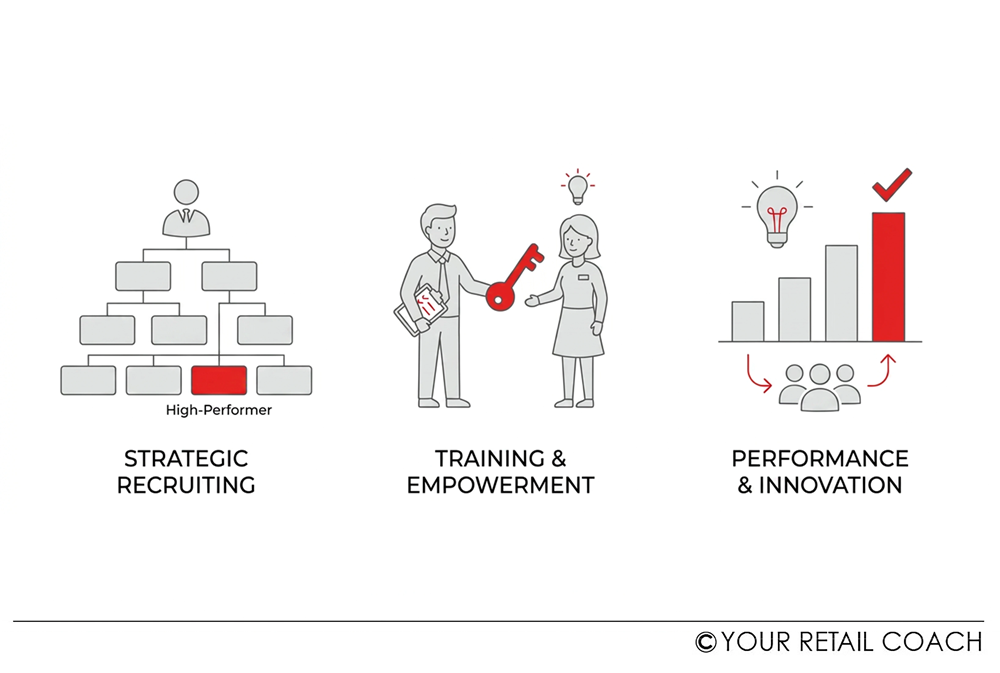
In building a high-performing team in fashion retail, organisations must emphasise recruitment and selection, onboarding and training, the approach of internal communication, employee empowerment and workplace autonomy, rewards and recognitions, and work culture. These are generic areas of work, but the nuances specific to the fashion business and industry must be duly taken into consideration and incorporated. For example, in fashion business recruitment and selection, evaluation should be based not only on surface-level requirements but should be also targeted to check whether candidates have a genuine interest and passion and a proactive attitude towards fashion, sales, and dealing with customers. Similarly, in fashion retail training, employees need to be educated well on products and services while delving into technicalities such as fashion, fabric, fit, sustainability, styling versatility, and care instructions. Sales staff should also be trained on techniques in specific areas of sales, customer service, visual merchandising and planograms. And on the front of what should be the communication philosophy and approach in a fashion retail enterprise, there should be an emphasis on helping employees resonate with the brand persona, tone, and voice. The same curated approach is required in the other mentioned areas of work as well – employee empowerment and workplace autonomy, rewards and recognitions, and work culture.
About Your Retail Coach
We are a retail and eCommerce consulting enterprise with a growing network of offices globally. In a span of over 10 years, we have worked with over five hundred clients in more than twenty-five sectors, with an accomplishment rate of over 94%.
To speak to a fashion retail consulting professional, feel free to drop us a message, and we will shortly reach out to you.
FAQs
As a business owner of a fashion retail enterprise, how do I keep my sales team motivated?
Start with an acknowledgement that it is less likely that you would land up with a perfect and prepared team, but instead you might actually have to build a fit team. Therefore, you must think long-term and seek to ensure that your employees have strong tangible and intangible reasons to stay. Here are some areas to work on that can help in retail sales staff motivation:
- Recruit strategically (look for candidates who align with your organisational values and intended work culture and already have interest and inclination for sales, customer service, communication, etc.)
- Pay fairly and competitively (if you do not do this, competitors might take advantage)
- Provide non-financial incentives (financial aspects do not always remain attractive)
- Provide job-oriented training (provide training that is related to job profiles)
- Avoid burnout, use shift-based models, provide a work-life balance, offer duty exchange
- Keep realistic targets (keeping unrealistic targets might be counter-productive to customer experience)
- Focus on building a productive, cordial, and collaborative work environment
- Maintain diversity in team formation
I find it hard to find suitable sales staff for my fashion retail startup. Suggest some solutions.
You are not alone; almost every big and small fashion brand faces this challenge. Here are some ideas for deliberation:
- Broaden your search (try new channels of advertising like Facebook and WhatsApp. You need not always land on the digital screens of the candidates; even your customers could pass on the news of vacancies to potential candidates.)
- Use employee referrals (whether family or friend of an employee, it should not come at the cost of any kind of deviation from the established recruitment and selection criteria).
- Go for average candidates and then train them well
- Introduce part-time employment (without any compromise on hiring and onboarding standards and policies)
- Do some work on your branding as a hiring organisation
- Deal with your employees as if they are one of the stakeholders of your business.
- Automation of jobs that do not necessarily require any human involvement (e.g., the use of Self-Checkout Kiosks, smart shopping carts, Just Walk Out, smart shelves, etc.)