
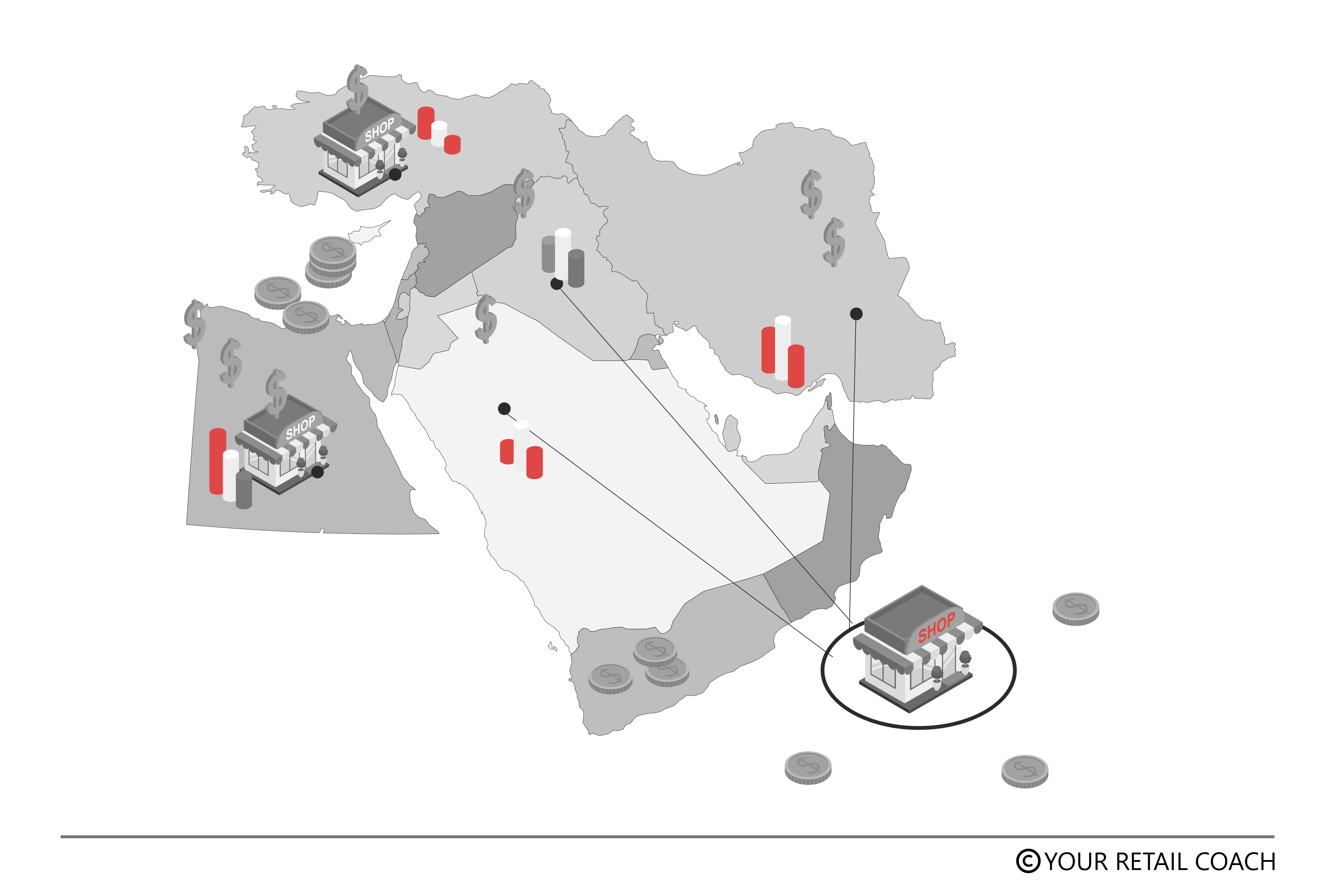
As retail continues to thrive across the Middle East, particularly in the UAE and Saudi Arabia, developing your store portfolio continues to be a strategic concern. With evolving customer preferences, increased competition, and high real estate costs, retail chains need to ensure stores are presence and performance-based. Planning a well-thought-out store network, or footprint, can minimize operational costs, maximize revenue, and improve ROI.
For retailers with multiple store locations, footprint optimization means balancing existing market penetration with opportunities for growth in less-saturated markets. Planning for store networks regionally is more than just adding stores; it’s about adding the right stores. It’s a combination of retail site intelligence, commercial real estate site planning, and a form of growth consulting that reflects the brand’s longer-term retail growth plan. In an era of shopping economy where walk-in traffic is key and digital competition is a growing threat, utilizing every square meter decisively is more important than ever.
Evaluating Market Entry Strategy Through Local Insights
A successful market entry strategy in the Middle East starts off by understanding the subtleties in the region, ymmv “nuances”: everything from cultural choices, purchasing power- to regulation. Other than not personally stepping out as retailers in a new city or new country in the region, you need to rely on local knowledge to help avoid a self-inflicted error that could turn out to be costly and therefore acquiring the necessary research and leverage from local market experts comes in handy. Selecting a site in Riyadh is through a different few glasses of eyewear than one in Dubai or Muscat.
Visitor flows, population concentration, land use restrictions, and re-buying patterns can affect store performance. Here tailored research collaboratively drawn from local market experts can contribute to educated assumptions. When subsequently optimizing the multi-store network in the region, each entry store needs to be perceived as a seamless continuation rather than one of many wagers. Thus, a solid market entry strategy should not only save poor site selection, but also shape a regional retail growth strategy for sustainable retail growth.
Retail Site Planning for Footfall and Profitability
Establishing retail sites is critical to optimizing your network, which can be quite complicated in a region like the Middle East where cultures can be very different and the geography can be extensive. Obviously, a retail site involves more than just rent. You also need to consider visibility, access, anchor tenants, people patterns, as well as proximity to competitors. When retailers have lots of stores, they need to do site planning consistently while allowing for differences in each local market. However, after the site plan is decided, how the store is laid out determines how long customers will stay and will also increase average transaction values. In determining potential sites, retailers should involve statistical methodologies, including heatmaps, customer journeys, and even satellite images. Likewise, retailers also need to consider leasing and flexibility arrangements; integration with logistics and e-commerce; and parking issues.
Leveraging Retail Chain Expansion Consultants
Retail chain expansion consultants provide extraordinary diversity with multi-market expansions in the Middle East. These consultants back their expertise with data regarding everything from market entry strategies, to market entry methods and brand benchmarks, and competitor assessments. Their conclusions help brands avoid saturating their growth, create low-investment-risk markets, and provide a quicker path to profit.
Consultants active in the Middle East have the advantage of knowing how to deal with local conditions; this includes, regulations, local hiring, negotiations on real estate, and localization of the brand and they contribute third-party objectivity that challenges internal biases and enhances decision making. Their use can help retailers avoid delays, drive down CapEx outlays, and grow fast.
Consultants also provide value from the early stages of feasibility assessments and market-level assessments, to post-launch performance audits, retail chain expansion consultants will be co-pilots to retailers in an increasingly complex expansion landscape. They have the ability to help retailers build a much faster, more agile and higher-performing store network.
Strategic Expansion Roadmap
Instead of a plan, a growth roadmap is a strategic tool for sustainable / scalable retail profit. In the Middle East, retailers often face fragmented expansion due to incomplete infrastructure, labour availability or real estate volatility. A proper roadmap considers market maturity, market competition, urbanization patterns, and feasibility. Retailers need to determine what cities are fit for flagship stores, and which are more appropriate for smaller footprint stores / experiences.
Getting this clarity ensures that all new stores nurture the wider retail system instead of adapting into existing stores. Additionally, predictive analytics and performance modeling will allow retailers to visualize points of market saturation, white spaces and opportunities. This applies to a retailer’s decision to aspire to be a luxury retailer in Dubai or aspire to be a convenience-based store in Bahrain. A roadmap allows retailers to ensure every move is done strategically, sustainably, and equitably and is consistent with the brand.
Aligning Store Networks with Retail Growth Strategy
To thrive in the ever-changing retail environment of the Middle East, a retailer’s store network must be a part of their retail growth strategy, not an after-thought or secondary consideration. A store network that takes into account the overall retail growth strategy ensures that each store showcases the brand in a manner that positively positions the brand in the minds of consumers, achieves long-term revenue objectives, and drives customer experience. For example, while premium priced fashion brands may chase high-footfall malls in Dubai, budget-focused retailers may push suburban expansion in Saudi Arabia.
Integrating store formats, sizes, and locational characteristics with changing consumer needs will ensure that stores remain relevant and profitable. Retailers should use internal data, such as sales performance, inventory turnover and customer feedback, as ongoing input into store network strategies. Growth without this alignment often leads to incoherent brand storytelling, higher than necessary operational costs, and failure to capitalize on opportunities in the market. Without this level of integration, retailers risk jeopardising the value brand upon which they depend for success: a more replicated brand value across geography/store type and a competitive foundation for growth.
Technology and Analytics in Growth Advisory Services
Today’s growing advisory services are to a large degree dependent on technology and data analytics for store network optimization. Geographic Information Systems (GIS), AI demand forecasting and location intelligence platforms have transformed the ways retailers assess store growth strategies. As an example, all the ground-level data to understand changes in the population movement patterns, income distribution, retail voids and footfall potential in the Middle East now has greater validity with the use of these tools.
Growth advisors harness this information to create a ‘digital twin’ of a store’s performance, demand chop delivery network design and hyper-localised activation strategies going forward; whether it’s to benchmark ROI for a new store in Sharjah or to assess if a loss-making store in Jeddah deserves to be closed. Analytics will have educated the objective analysis of a ‘Go’ decision. As competition increasingly heats up and consumer habits change exponentially quicker, instinct and intuition are losing currency. Growth Advisory firms that can offer tech-enabled solutions are enabling retailers to build future-proof networks based on real time data and strategic landscape changes.
Making Smarter Store Decisions with Optimized Networks
In a region where change is constant and opportunities are many, multi-store retailers across the Middle East must adopt a more intelligent, data-driven approach to network optimization. It’s not simply about being everywhere; it is about being exactly where your customer is expecting you to be. All the way from publishing targeted expansion roadmaps to retail chain expansion consultants and advanced analytical practices should all be a part of a broader retail growth strategy. Network optimization is not only good for the bottom line, but it is imperative for ensuring sustainable leadership in the market. Retailers who will thrive in this newly evolved ecosystem will be those that consider network optimization as an ongoing strategic process, rather than a task. With the Middle East retail industry moving toward modernization, the time to optimize is now.
How can an expansion roadmap assist retail chains in the Middle East?
Why is a market entry strategy necessary for retail chains in the Middle East?
What do retail chain expand consultancy services do concerning store planning?
Retail chain expansion consultants obtain and analyze the local trade area data required to make site selection decisions; legal and compliance information, and operational performance goals and timeframes. By partnering with proven retail chain expansion consultants, you will have the benefit of their assistance to speed up the market penetration process through your store network optimization decisions.
In what way does retail site planning compliment growth advisory services?
Retail site planning establishes that each store location meets all the visibility, customer access, and foot fall requirements for each assigned location. When retail site planning is attached to growth advisory services, it assists long-term profitable retail margin optimization and reinforces the brand’s position in the market.